





EV Information

An Electrifying Direction for Chevy Vehicles
The all-electric vehicle era is here, and it's not going away. Every year electric vehicles are evolving and more consumers are purchasing electric after learning that an EV works for their lifestyle in one way or another. If you're looking for information that can help you determine whether you should buy an EV or not then you've come to the right place. We have all the information you need from how EVs work to frequently asked questions and myth busting facts. From electric SUVs to electric trucks, we offer a broad lineup of stylish and practical EVs that can get you where you want to go — so you can do whatever it is that drives you.
Electric vehicle highlights
 The power of choice
From electric SUVs like Equinox EV to electric trucks like Silverado EV... it’s easy to find an all-electric vehicle with the style, capability and features you’re looking for.
 Charging convenience
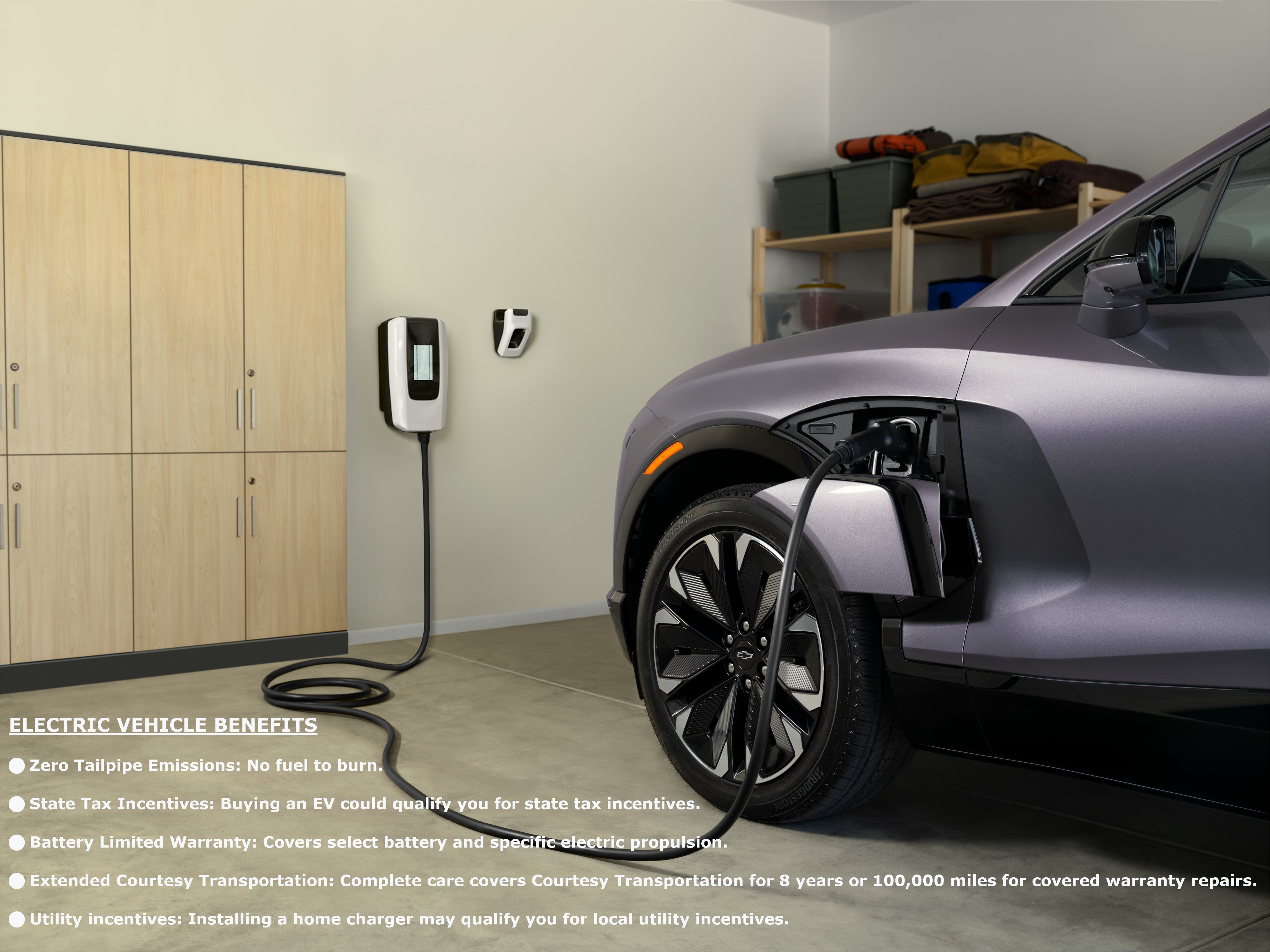
Every Chevy EV comes with a variety of easy-to-use charging options. Choose from over 195,000 public chargers – or enjoy the convenience of an overnight charge at home.
 No range anxiety here
You’ll enjoy the freedom and confidence that comes from driving a Chevy EV with ranges of up to 320 miles on a full electric charge.*
Helpful FAQs
How long do electric vehicle batteries last?
It depends on usage, but Chevrolet warranties their EV batteries for 8 years or 100,000 miles (whichever comes first, see dealer for details).
Do electric vehicles use oil?
No. EVs have different drivetrains, fewer moving parts and electrical engines that don’t require lubrication.
How do electric vehicles work?
A large electric battery supplies power to one or more of the electric motors to drive the wheels. Between drives, the owner can plug their EV into a charging station to recharge the battery.
Do electric vehicles have transmissions?
No, but there is often a stepdown gear to convert the higher motor RPMs to an appropriate wheel speed.
Are electric vehicle batteries recyclable?
Yes, GM has developed recyclemybattery.com to help recyclers repurpose as much of the batteries as possible.
Which electric vehicle has the longest range?
The Chevy Silverado EV 4WT. This electric truck has an EPA-estimated 450 miles of range.*
Which is the largest electric SUV?
Chevrolet’s largest electric SUV is the 2024 Blazer EV, with a length of 192.2 inches, a width of 78 inches and a height of 65 inches.
Can electric trucks tow?
Yes, absolutely.
The truth about EVs - Myth Busting Facts
Electric vehicles are fun to drive, easy to live with, and great for people in all walks of life. We bust some outdated myths about EVs.
All over America, more people are learning just how easy electric vehicles are to use and integrate into their daily lives. For everything from around-town errands to road trips, EVs are proving themselves capable and cost-effective. In fact, the number of all-electric vehicles sold in the U.S. has climbed every year since 2011, adding up to more than 2.4 million as of November 2023.
Myth: There’s nowhere to charge
Fact: You can easily charge at home. Most 120-volt home outlets are capable of charging an electric vehicle overnight, using a Level 1 charging cord. Chevrolet recommends a professionally installed 240-volt charging unit, known to EV drivers as a Level 2 charger, as the best way to charge the Bolt EV. Chevrolet has partnered with Qmerit to connect Bolt EV owners with accredited home EV charging station installers across North America. When you’re not home, there are about 90,000 compatible public charging outlets in the U.S. and Canada, and GM is working with EVgo, the largest public fast charging network in the nation, to install even more public chargers across America over the next five years.
Myth: Charging an EV takes too long
Fact: Home charging is a game changer. On a Level 2, 240-volt charger, your Bolt EUV can grab up to 25 miles of range per hour while you sleep, binge your favorite show, or play with the kids. Don’t have a charger? No sweat. Our partners at Qmerit make adding one to your home a breeze. So, instead of thinking in terms of hours to refill an empty pack, think of home charging as something that happens while you live your normal life.
Myth: EVs don’t offer enough range
Fact: The vast majority of daily trips can easily be handled by an electric vehicle like the 2024 Equinox EV or Blazer EV, which have an EPA-estimated range of 300 to 320 miles on a full charge. For example, the distance driven by the average driver for any reason each day in the U.S. is about 29 miles. An EV also makes an excellent vehicle for getting to the job, since the average commuter only travels about 40 miles per day.
Myth: EVs can’t be used for road trips
Fact: They can. Depending on the destination and time targets, almost any trip is possible. There are any number of websites that can help new owners of electric vehicles plan their trip, and the myChevrolet Mobile App has features to help you adjust your route in real time to meet your energy needs. The app’s energy bubble tool will let you see your car’s current range on a map using the vehicle’s current information. The app can also show detailed information about charging locations, including pictures, hours of operation, availability, and when a charging station was last active. Finally, the myChevrolet Mobile App can set up a drive route based on the battery’s current state of charge and charging locations along the way. It will even let you open that route in your preferred map app.
Myth: EVs don’t work well in cold weather
Fact: Preheating your EV makes for a toasty drive and can save energy for range, but remember — whether they’re powered by gasoline or electricity, all vehicles are less efficient in the cold. The EPA says that when temperatures dip below 20 degrees Fahrenheit, cars with all kinds of powertrains — from gasoline to hybrids to fully electric vehicles — are less efficient in a mix of city and highway driving than they are at higher temperatures. The critical caveat is that much of the extra energy an EV needs in winter is used to heat the cabin. If you preheat the cabin before leaving, while the vehicle is still plugged into the charger, you can help extend the vehicle’s range for that trip.
Myth: EVs are expensive to own
Fact: The value of an electric vehicle isn’t always apparent by comparing its sticker price to that of a similar internal combustion engine vehicle. For example, when compared to a new, similarly sized gas-powered vehicle, a 2024 Silverado EV can save a driver over $8,000 in fuel costs over five years, the EPA estimates. That number changes based on how much someone pays for gasoline, their electricity costs, and how many miles they drive each year, but in any case, it’s a chunk of change. Plus, some utility providers allow customers to pay less for electricity at night, and Silverado EVs can be programmed to take advantage of these lower off-peak rates by only charging when most people are asleep. And the Silverado EV doesn’t use engine oil, so you can skip the costly oil changes.
On-the-go charging
Recharging while you’re on the move is as easy as pulling in, plugging in and charging up. With over 195,000 available public charging stations, you’ll have no problem finding one nearby. Need something faster on the fly? Try DC Public Charging, with a GM-estimated 100 miles of range in only 10 minutes** — twice as fast as some of our competitors.
Find your nearest EV charging station by using this handy PlugShare map so you'll know your EV will be charged up no matter where you drive.
Just type in your address to find the nearest charging station to get you back on the road as quickly as possible!
*On a full charge. Actual range may vary based on several factors, including ambient temperature, terrain, battery age and condition, loading, and how you use and maintain your vehicle.
**Actual charge times will vary based on battery starting state of charge, battery condition, output of charger, vehicle settings and outside temperature.